
How Long does Invisalign Take to Work?
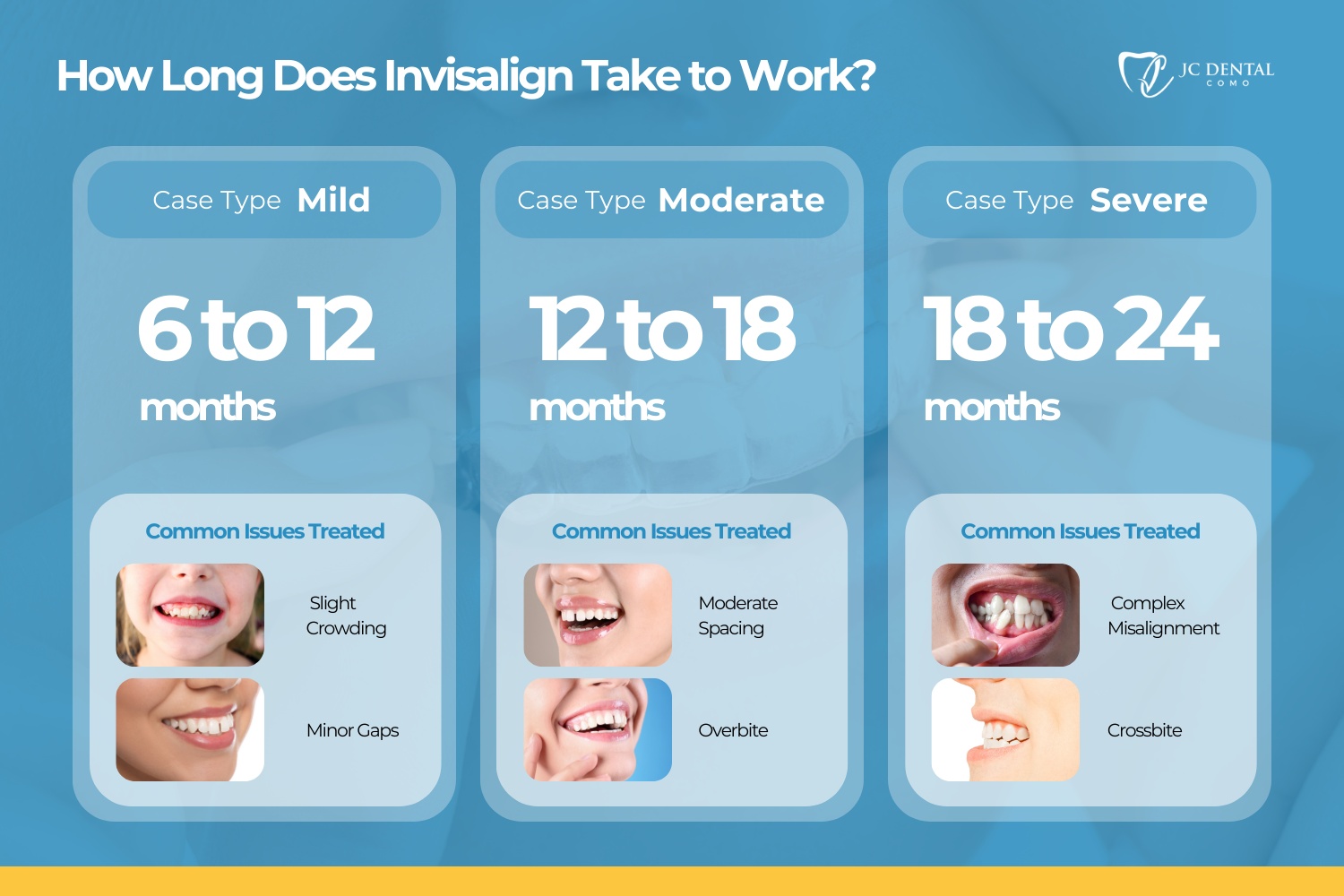
Invisalign takes between 6 and 24 months to work. In mild cases of crooked teeth, Invisalign will slowly correct the position of teeth within 6 to 12 months. However, severe cases take more time, and you can start seeing results within 18 to 24 months of using Invisalign.
Invisalign has grown in popularity thanks to its comfort and aesthetic benefits. According to Invisalign, over 19 million people worldwide have started wearing Invisalign aligners. Plus, around 5 million of those are teenagers — a number that’s only growing!
More and more dentists are becoming experienced at fitting Invisalign clear aligners. At JC Dental Como, we follow a step-by-step protocol to help you find the perfect fit for your teeth. This process involves:
- A consultation to evaluate your teeth
- A digital scan of your mouth and jaw
- Development of a custom treatment plan using Invisalign’s state-of-the-art software
- Ordering aligners from Invisalign’s laboratory
- Testing and fitting the aligners
One of the first questions many patients ask us is, “How long does it take for Invisalign to work?” As we will see, the answer to this question varies depending on a few factors. Let’s delve into this topic more deeply so that you can make an informed decision about straightening your, or your child’s, teeth.
Key Takeaways
- Invisalign treatment takes an average of 18 months to complete.
- Most patients start seeing results from Invisalign within 6 weeks of starting treatment.
- Factors like not wearing your aligners for 22 hours every day can prolong your treatment duration.
- You’ll need to collect your new aligners every 7 to 14 days during the treatment process.
What is the Average Duration of Invisalign Treatment?
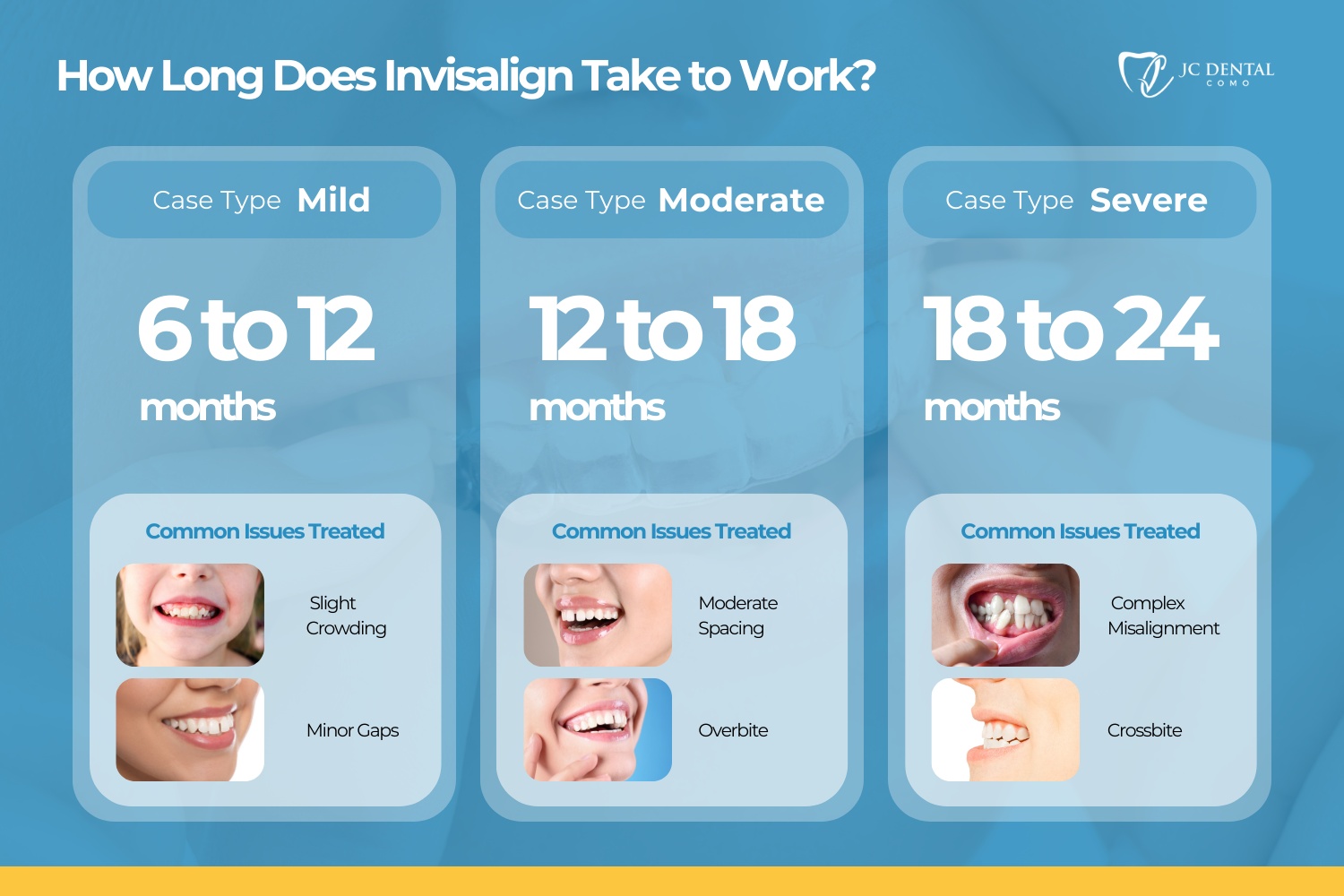
The average duration of Invisalign treatment is 18 months. This takes into account that some treatments with Invisalign take as little as 6 months to conclude, whereas more complicated treatments take up to 2 years. For most patients, Invisalign treatment takes 12 to 18 months, but you can start seeing results within as little as 2 to 6 weeks.
| Case Type | Treatment Duration | Common Issues Treated | Average Number of Aligners | Time to Noticeable Results |
|---|---|---|---|---|
| Mild | 6 to 12 months | • Slight crowding • Minor gaps | 10 to 25 aligners | 4 to 6 weeks |
| Moderate | 12 to 18 months | • Moderate spacing • Overbite | 25 to 40 aligners | 6 to 8 weeks |
| Severe | 18 to 24 months | • Complex misalignment • Crossbite | 40+ aligners | 8 to 12 weeks |
What Factors Influence the Length of Invisalign Treatment?
Factors that influence the length of Invisalign treatment include:
- How severe the problem is that’s being treated
- An inability to wear aligners for 22 hours each day
- Not being consistent in collecting new aligners every 7 to 14 days
- The age of the patient
- Unprofessional treatment plan
How Can You Speed Up the Invisalign Treatment?
To speed up your Invisalign treatment, you should stick to the 22-hour rule, get and use your new aligners on time, have any conditions treated before starting, and always use a qualified dentist. These factors will affect treatment, so it’s worth looking at each one more in-depth. This way, you’ll know exactly what to expect and how you can speed up your Invisalign treatment.
1. Be Diligent: The 22-Hour Rule for Wearing Aligners
Dentists will tell you that Invisalign is way more effective if worn for 22 hours per day. This gives you more than enough time to take the aligners out for brushing, eating and drinking, and flossing or rinsing your mouth.
This 22-hour rule maintains consistent pressure on the teeth, which ensures that the teeth are shifted to their desired position. Remember that the younger you are when getting Invisalign, the quicker this correction will take place.
2. Be Consistent: Get New Aligners Regularly
One of the main reasons for Invisalign not working is the patient’s neglect. When using Invisalign, make sure you visit your dentist regularly to get new aligners. Each aligner is different, and they must be worn in the correct successive order to be effective.
3. Ask Your Dentist: Deal with Tooth Issues First
How long is Invisalign effectiveness if you have pre-existing tooth issues? Aligners will not be very effective if you have tooth decay or gum disease. These issues should be dealt with first before you start your Invisalign treatment.
At JC Dental Como, we make sure your teeth are free of tooth decay problems and gum disease before starting Invisalign. This way, the treatment will work efficiently, faster, and have lasting effects on your teeth.
4. Use a Good Dentist
Always use a dentist that is familiar with Invisalign. They should also have information on their website about this treatment, as well as the Invisalign software in their offices. Not every dentist is trained on how to use the software, so choose a dentist with lots of experience in this field.
How Often are New Aligners Provided During Treatment?
You’ll be provided with new aligners every 7 to 14 days during the treatment. This means that for mild cases, you can expect to use between 10 and 25 aligners. For more serious cases of crooked teeth, up to 40 aligners or more are necessary during treatment, and each one should be obtained every 1 to 2 weeks.