
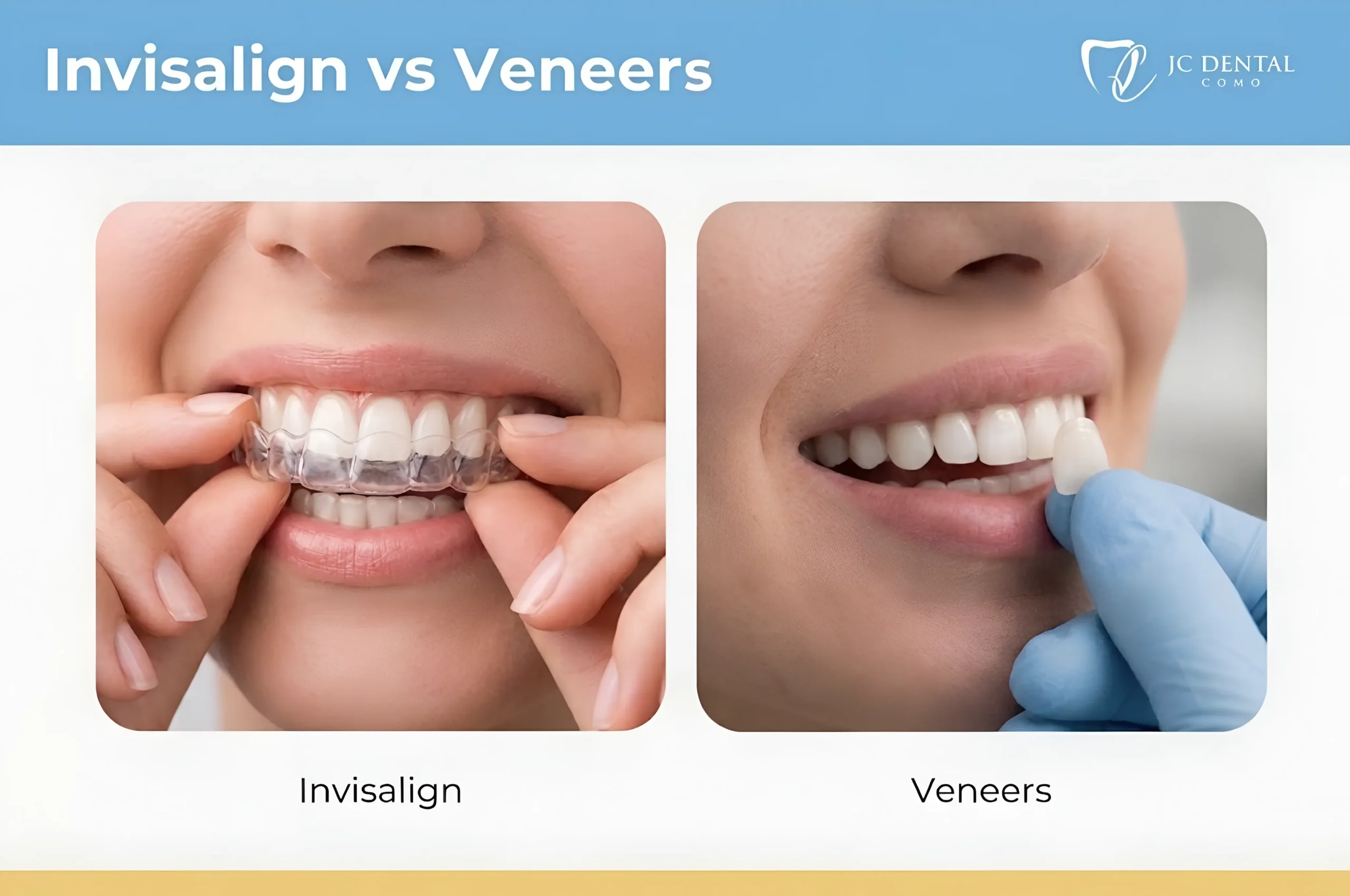
Invisalign vs Veneers: Which Is Suitable for You?
The best cosmetic dental treatment is not always the one that looks the most dramatic on day one. When weighing up Invisalign and veneers, many people assume porcelain restorations are the only shortcut to a perfect smile. However, the foundational difference is simple: Invisalign physically moves your natural teeth into healthier positions, while veneers act as a cosmetic cover to mask the front surface of your teeth.
If you are looking in the mirror wondering whether Invisalign or veneers will suit your goals, understanding this distinction is crucial. This guide covers everything from biological costs to financial realities, giving you a clear path to decide which treatment truly fits your lifestyle and oral health needs.
Invisalign vs Veneers at a Glance
If you are looking for an immediate breakdown, the table below highlights the core differences between orthodontic movement and cosmetic masking.
| Feature | Invisalign | Veneers |
|---|---|---|
| Main Function | Corrects alignment and bite structure | Alters shape, shade, and visible symmetry |
| Enamel Impact | Zero enamel removed | Permanent removal of a thin enamel layer |
| Timeline | 6 to 18 months on average | 2 to 3 appointments over a few weeks |
| Longevity | Lifelong results with retainer use | 10 to 15 years before replacement |
| Pain Level | Mild pressure tenderness | Local anesthetic used; mild sensitivity |
| Reversibility | Fully reversible | Irreversible commitment |
What Is the Difference Between Invisalign or Veneers?
At their core, these two treatments are entirely different answers to the same question of how to improve your smile. One corrects the structural architecture, while the other refines the aesthetic facade.
How Invisalign Works?
Invisalign is an orthodontic system that relies on a series of custom made, clear removable aligners to gradually shift your teeth into their correct positions. By taking a digital scan of your mouth, your dentist maps out precise movements. You wear each set of trays for one to two weeks, applying gentle pressure that physically moves the roots of your teeth. Because you can remove the trays to eat and brush, it is a highly convenient way to address the underlying structure of your smile without brackets and wires.
How Dental Veneers Work?
Veneers are ultra thin shells made of porcelain or composite resin bonded directly to the front surface of your natural teeth. To ensure these shells sit flush and look perfectly natural rather than bulky, a dentist must permanently remove a small fraction of your tooth enamel. Once applied, veneers instantly change the color, shape, and size of your teeth. They do not move your teeth; they simply camouflage them, delivering rapid aesthetic perfection.
Invisalign vs Veneers for Gaps: Which Closes Spacing Better?
Many patients seek cosmetic dentistry specifically to address diastema, the clinical term for spaces between teeth. Choosing Invisalign vs veneers for gaps depends heavily on the size of the space and the overall health of your bite.
Invisalign closes gaps by applying controlled force to slide your teeth closer together. This is often the preferred method because it corrects the root position and preserves your natural tooth structure. If you have multiple gaps spread across your upper or lower arches, aligners will distribute your teeth evenly for a balanced, healthy bite.
On the other hand, veneers close gaps through visual illusion. The porcelain shells are crafted to be slightly wider than your natural teeth, effectively bridging the empty space when bonded. This approach works beautifully for a single minor gap between your front teeth. However, if the gap is too wide, using veneers can result in teeth that look unnaturally broad or square.
Should you consider Invisalign?
Clear aligner therapy requires patience and daily discipline, but the structural benefits are unmatched. When deciding should you consider Invisalign, evaluate whether your dental profile matches the following criteria:
- You want to keep your natural tooth enamel completely intact without permanent alterations.
- You struggle with an overbite, underbite, crossbite, or significant crowding that affects your daily bite function.
- You are disciplined enough to commit to wearing your removable trays for 20 to 22 hours every single day.
- You have a flexible timeline of six months or more to achieve your ideal smile.
- You want a discreet solution that lets you continue your normal eating and brushing routines.
Should you consider Veneer?
Porcelain restorations are designed for individuals seeking a complete aesthetic transformation in a very short timeframe. You should you consider veneer placements if you relate to these scenarios:
- You have deep, intrinsic staining or discoloration that professional teeth whitening gels cannot remove.
- You want to fundamentally change the actual shape, length, or symmetry of your teeth.
- You have minor chips, surface cracks, or worn edges that make your teeth look prematurely aged.
- You are working toward a tight deadline, such as a wedding, and need a total smile makeover in just a few weeks.
- You are fully comfortable with the irreversible process of enamel removal and future replacement cycles.
Pros and Cons for Invisalign and Veneers
To make an informed decision, it helps to review the Invisalign or veneers pros and cons side by side. Both have distinct advantages and biological trade offs.
| Cosmetic Dental Treatment Option | Advantages | Disadvantages |
|---|---|---|
| Invisalign | Completely preserves natural enamel Removable for unrestricted eating Improves long term gum and bite health | Requires strict daily wear compliance Takes months to see final results Cannot change tooth color or shape |
| Veneers | Instant cosmetic transformation Highly resistant to future stains Hides chips, cracks, and uneven edges | Requires irreversible enamel removal Needs eventual replacement over time Higher initial cost for a full smile |
How Long Do Clear Aligners and Veneers Last?
The biological cost and longevity of these treatments dictate their true value. Invisalign provides a lifelong structural correction, provided you follow one crucial rule: consistent retainer use. Teeth have a natural memory, and without a retainer, they will slowly drift back toward their original misalignment. With proper retention, your results are permanent.
Veneers are highly durable and routinely survive for 10 to 15 years with excellent care. However, they are not lifetime restorations. Because natural enamel was removed to place them, replacing them is a mandatory requirement once they reach the end of their lifespan. To maximize their durability, you must avoid habits that chip porcelain, such as biting your nails or chewing ice, and wear a nightguard if you grind your teeth.
Is Invisalign or Veneers Better?
When evaluating whether Invisalign or veneers better, the answer lies in your primary goal.
Choose Invisalign when you want true tooth movement for a healthier bite and natural aesthetics. It is the superior choice for resolving foundational crowding and misalignment without sacrificing healthy enamel.
Choose veneers when your teeth are generally straight but suffer from severe cosmetic defects like permanent stains, uneven sizes, or heavy wear. They offer an unparalleled, immediate visual upgrade that alignment alone simply cannot achieve.
Invisalign and Veneers Before and After Expectation
Understanding Invisalign and veneers before and after expectations will ensure you are thrilled with your final result.
With clear aligners, your transformation happens progressively. Through digital imaging during your consultation, you get a highly accurate preview of your future smile. The final result will be your own natural teeth, looking perfectly straight and easier to clean.
With porcelain restorations, the visual shift is dramatic and immediate. You walk into the clinic with worn or discolored teeth and leave with a bright, symmetrical, Hollywood standard smile.
Can You Combine Both Clear Aligners and Veneers?
Many top tier smile makeovers do not force you to choose just one option. A clinician led, sequenced approach often yields the most stunning and conservative results.
By undergoing Invisalign treatment first, your dentist moves your teeth into optimal alignment. Once your bite is stable, they can apply ultra thin, conservative veneers to just a few select teeth to perfect symmetry and shade. This staged method minimizes enamel reduction while delivering a flawless aesthetic finish.
Frequently Asked Questions
1. Should I do Invisalign or veneers?
If your root problem is structural alignment, crowding, or a poor bite, Invisalign provides the necessary foundational fix. If your main issue is the surface appearance, color, or shape of the enamel, veneers deliver immediate polish.
2. Is Invisalign or veneers better for gaps?
For large or multiple gaps, Invisalign is safer because it moves the entire tooth to close the space naturally. Veneers are excellent for instantly hiding a single, minor gap between two front teeth.
3. Can I get Invisalign if I already have veneers?
Yes, clear aligners can often be used over existing veneers, but it requires precise clinical planning. Your dentist must carefully place temporary movement attachments to avoid damaging the delicate porcelain surface.
4. Do veneers ruin your natural teeth permanently?
Placing porcelain requires the irreversible removal of a thin layer of healthy enamel. While the word “ruin” is extreme, the biological change is permanent, meaning your tooth will always require a restoration covering from that point forward.
5. Is Invisalign painful compared to getting veneers fitted?
Aligners cause mild pressure and tenderness for a day or two after switching to a new tray. Getting veneers fitted involves local anesthetic during the preparation phase, so the procedure itself is comfortable, though you might experience minor sensitivity afterward.
6. Can I get veneers on my top teeth and Invisalign on the bottom?
Yes, mixing treatments across different arches is a very common strategy. Many patients choose rapid cosmetic perfection for their visible upper teeth while using aligners to correct hidden crowding on their lower teeth.
7. Will my health fund cover Invisalign or veneers?
Health fund coverage depends entirely on your specific extras policy. Orthodontic benefits frequently cover a portion of Invisalign fees. Because veneers are classified as purely cosmetic, they rarely attract any meaningful rebate.
8. What happens if a veneer chips or an aligner is lost?
A chipped veneer requires a prompt dental visit for assessment and potential replacement to protect the exposed tooth underneath. If you lose an aligner, contact your clinic immediately; they will typically advise you to advance to the next tray or temporarily revert to a previous one.